
Cutting Tools: How Equipment Is Bought and Judged (Chapter 2)
How cutting tools are bought and judged in Chapter 2: money earned from cutting funds a suggested buy order, and each new tool is speed-tested against the last before mom gets home.
Quick answer
Cutting tools in [🧪 CHAPTER 2] Cut all the Grass! exist for one job: clear the entire front yard — “Cut every last patch of grass” — then “Finish before your mom gets home.” The countdown is enforced live during play, and clearing inside it is what updates your best time.
- Time pressure is real: in a Chapter 2 run, time remaining was called out mid-game — 25 minutes left, later 19. Those are snapshots of that run, not fixed values.
- Tool speed is judged against the timer and the best time, which is why every purchase in the observed loop gets speed-tested immediately.
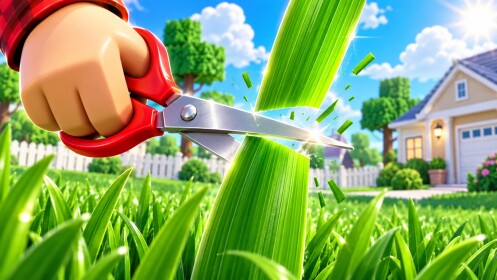
How cutting tools are acquired: save up, buy in order, test against the last one
Chapter 2 treats the cutting equipment as an upgrade sequence, and a playthrough of the current build shows the full loop — without naming a single tool. The player saves up for the next purchase (“My dad told me to save up for this, but we're supposed to get this first”), buys it (“we're going to buy this now... Let me try these out”), and immediately runs a speed test against what came before: “I need to get faster... How is this so good? How is it? Which one is better?”
The narration treats the set as an ordered path — “you try to get this first. And then it was this. Then it was that” — and questions a later buy the same way: “How is this better than the thing while...” The result is an upgrade sequence in which each new purchase is measured on speed against the tool before it. That run never speaks a tool name, a price, or how long any tool lasts, and the buy order is one player's observed Chapter 2 path rather than a documented required progression — treat the in-game shop as the authority on the current lineup after store or balance updates.
Where the money comes from, and how the run progresses to the end
Cutting itself pays. In the same Chapter 2 run, clearing grass hands over money — “we got money for it” — and that is what funds the purchases described above. Overall completion is tracked as a percentage (“We're on 84%”), the run moves through distinct named areas and stacked layers — the soccer field, the backyard, and a “final layer” the player asks about — and it ends at “I completed the entire game.” That gives the equipment economy its observed shape: earn money from cutting, spend it on the next tool in the order, and clear area by area until the yard is done.
What that loop doesn't settle — which tools exist by name, what any of them costs, or whether one carries over between runs — is something to read off the in-game shop on a current build rather than assume from any single playthrough.
Related Guides
Coins: Earning Money at the Soccer Field
Earn money by scoring at the repeatable soccer field, then spend it on the intended sequence of gear upgrades.
How to Finish the Yard
See what counts as a finished yard, how the completion percentage tracks progress, and what to check when grass seems left over.
80 Minute Timer: When It Starts and How It Counts Down
Find when the 80-minute deadline starts, what finish-before-mom-gets-home really asks, and which countdown checkpoints a full playthrough recorded.